

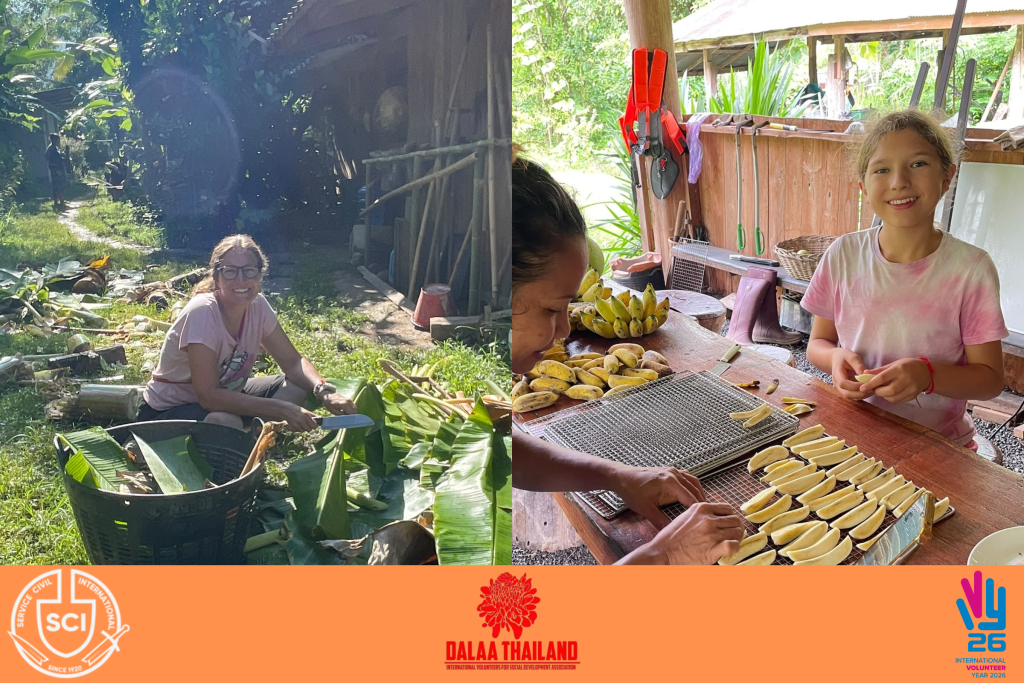
Michaela and Vitus, from Austria
One-month volunteering at Hug Baan Den Organic Farm, Thailand
When Michaela started looking for a volunteer project, she was not only looking for herself. She was looking for something she could share with her son, Vitus. That is how mother and son ended up at Hug Baan Den, an organic farm in Northern Thailand run by Kru Ann, who returned to her family garden in 2023 and now welcomes volunteers to help sustain traditional agriculture: a garden of longans, pomelo, bananas and organic vegetables, worked the way it has always been worked.
For many organisations, hosting a child alongside a parent is still the exception rather than the rule. SCI’s volunteer camps and long-term projects are built on living and working together with the local community, and that structure is exactly what made this placement possible for a family. There was no separate “programme” for Vitus and no childcare to arrange: the farm simply became their shared daily life.
And that, Michaela says, is what the hosts understood best:
“For the hosts it was very important that the volunteers feel free and not under pressure. It’s their way of living and they want to give this feeling to the volunteers.”
That freedom turned out to be the key to the whole experience. The only “fixed schedule” was the nature and the local culture: thanks to that, mother and son could settle into the rhythm of the farm and the village.
“Nature was the topic number one, culture the topic number two. We felt part of nature and part of the village. The village is small so it’s easy to get in contact. We knew most people. Even to the monk we spoke to almost every day.”
The small scale of the village did what no structured integration activity could have done. Vitus was not a visitor being shown around; he was a child known by name, running through the same daily routines as everyone else. Learning happened sideways, in the middle of ordinary life: Michaela learned to cook with leftover ingredients and changed her habits towards a more sustainable way of living, while Vitus learned how to catch crabs without killing them. Neither lesson had been on any list of tasks. Both came from simply being there. A reminder to the saying: ‘It takes a whole village to bring up a child’.
Asked what the biggest benefit of the project was, Michaela’s answer was not a skill at all:
“Relax 😊 Honestly, it was so important to have time and to live this simple life, seeing and feeling how less you really need. It was, beside learning about plants and animals and the Thai culture, the biggest benefit.”
This is perhaps the most important thing about making projects accessible for parents and children: what a family takes home is rarely the thing that fits neatly into a work plan. It is the shared experience itself, the slowing down, the discovery that a good life can be built with less. For a mother and son, doing that together, in a community where they were welcomed as part of a family rather than accommodated as an exception, is what turned a volunteering placement into something neither of them will forget.
Michaela put it in words on their last day, standing together on the rice field, watching the sunset:
“As my child said on our last day: the life here has changed me in a way I could have never imagined. And I think it is this change we will take with us.”
Thank you, Michaela and Vitus, for sharing your story, and thank you to the hosts at Hug Baan Den for showing that when volunteers are given freedom instead of pressure, a project can welcome a whole family.
Sawasdee ka Thailand!
Are you a parent wondering whether volunteering with your child is possible? It can be. Have a look at the SCI project database or get in touch with our organisation: long-term@sciaustria.org or short-term@sciaustria.org


